What a joy it is to be back in this pulpit, back with you, back in church, back with our wonderful staff, back to work. I’m so grateful to be here.
Six weeks is a long time to be gone and I’m deeply grateful for all the support I received. Several of you mailed me cards. They seemed to come in at a steady rate of one a day, which meant a little joy was added to each day. The SPRC, and particularly our chairperson Cindy Jarrard, were hugely helpful and supportive, checking on Dana, praying for us and calling on others to do so as well. Some of you ran errands for Dana, brought food to the house, checked on us via text and phone call. What a blessing it was.
When we talk about fostering healing for the broken places of life, here in my life is a tangible example. We experienced the way this church loves, and in doing so, you fostered healing for the broken places of my life. For indeed, these past few months have been a place of brokenness.
Let’s hear our scripture for this morning. It comes from my favorite book of the Bible, Ecclesiastes.
Monday night at the hospital. The lowest point of this journey of illness. We received tremendous care from the hospitalist there, whose wife is friends with Dana from back when we all lived in Eastman. Po, the hospitalist, had been reviewing my case from when I went to the ER on the Friday before, giving us advice, asking good questions. When we arrived at the hospital Sunday, he had a battery of tests all lined up. I was quickly ushered to a room, where Po came to ask a series of questions, digging deeper into what was wrong. While he did, a phlebotomist took more blood out of me than I knew I had in me! Good thing I’m not squeamish.
After they’d left, someone came to transport me for a test. I didn’t have long to rest before another test was done. And another. And another.
Po kept us up to date, texting Dana results or coming by the room. We knew what was going on, what he was investigating, and what he had ruled out. It was incredible care. Indeed, with Po we saw where, “two are better than one.”
On Monday evening, he texted Dana with the result of an echocardiogram. I had minor heart failure. We already knew other organs, like my liver, spleen, and kidneys, weren’t functioning normally. CT scans showed that my spleen and liver were enlarged. Somehow, I was more okay with those organs having issues than my heart. We sat with this news. One of my first thoughts was, “this is how pneumonia kills people.”
Lying in my bed, holding Dana’s hand, I felt very alone.
It wasn’t the first time I’d felt very alone while sick. Since late September, I’d basically hidden how badly I was feeling much of the time. Some of you saw it as I went along, asking how I was doing, and I often replied the way I was talking to myself: downplaying just how bad I felt.
In late September, I got COVID. At least, I’m pretty sure that’s what it was. But whatever it was, it left me with lingering congestion and a cough. I also grew increasingly rundown. It was easy for me to blame it on stressors in my life. One of our friends had recently died of cancer. We’d buried her days before I got sick. Dana was still recovering from her surgery; a recovery that had proved more difficult than expected and taken a toll on the whole family. So I chalked my rundown, congested, feeling up to those stressors. I, of course, talked to Dana about my struggles, for she is incredible support and we have a marriage that daily reminds me how blessed I am by her. Otherwise, though, I remained solitary in my struggles.
Toward the end of October, I’d gotten bad enough to seek help. I did virtual care. They gave me an antibiotic and a steroid. I took them. They made me a little better. But I was still struggling. And again, I could look to my environment and blame that for my struggles. I told myself that life was increasingly stressful, for a variety of reasons, laying blame for my condition there. I decided if I managed my stress better, I’d improve. But I remained solitary in my struggles.
Early in November, I learned that my dad had serious heart issues. Quickly, they put in a stint. The procedure and further examination revealed that he’d had a heart attack and if they hadn’t caught it when they did, he would have probably had a very significant heart attack in the near future. It was hard news. I flew up to Pennsylvania to visit dad in the hospital, helping mom out, on a Friday. I flew back late Saturday and came to do church and then the church retreat with Anne Bosarge. Again, I told almost no one about any of this. And certainly, I didn’t mention that I was still suffering physically, now often coughing up mucus. I remained solitary in my struggles.
I recall meeting with a dear friend and mentor, Jay Pendleton, at around this time. In the course of the conversation, I told her how much I had been suffering and how much of a struggle it had been over the past few months. She rightly chided me for not telling her sooner, not seeking her support. She is part of my support system after all. Her words struck a chord, but I remained solitary in my struggles.
A day or two after the church retreat, I got much sicker, probably from something I picked up on the plane. Whatever it was, congestion got severe, coughing got worse, I’d go for walks with Quill, our dog, and would have to stop multiple times because I’d be hacking; I started to experience shortness of breath, and was really tired. And again, I thought it would pass. Again, I downplayed my symptoms. Again, I said I knew how to take care of myself and I’d do what my friend and former asthma doctor, David Plaxico, had taught me to do and eventually get better. I remained solitary in my struggles.
The night of the Interfaith Thanksgiving Service I felt terrible. But I carried on. The Thanksgiving service here that following Sunday, I felt awful. But I carried on. Over Thanksgiving, I felt even worse, but I carried on. I preached the next Sunday, feeling not only terrible but also very weak, but I remained solitary in my struggles.
The next day, I had to stop. My body was screaming at me. I did virtual care again. More antibiotics. More steroids. I went home. By the end of the week, my congestion was better, but I was very short of breath, very fatigued, and still coughing. I went back to work anyway, still downplaying my condition, remaining solitary.
The staff meeting on December 5 stands out in my head. I couldn’t focus on what anyone was saying. I was confused. I was struggling to follow along. I felt incredibly weak. Eventually, I couldn’t keep going and told everyone I was going home. I stumbled getting up from my chair because I was so weak. I drove home and couldn’t keep the road ahead of me in focus. In hindsight, I shouldn’t have driven. I got home and collapsed into the bed. The next day, I started my leave.
Something was very wrong. And I had, for two months, downplayed it. I told myself it was stress, and if I better managed my stress, it would go away. When I managed my stress better and was getting worse, I told myself that I would just have to take better care of myself physically, taking more time for rest, and I would get better. When that failed, I still told myself I could handle it. I told myself I didn’t need help. I told myself that I’d figure it out. I told myself that I had it under control. Looking back now, I can see how that was utter foolishness, but at the time, I remained solitary in my struggles.
Qoheleth, how we refer to the author of Ecclesiastes, has something to say to me, and to any of us who can tend to live such solitary lives. It’s utter foolishness, as he points out in verse 5. He calls such self-reliant, solitary, living vanity, a chasing after the wind; a famous phrase from throughout the book. He says, “there is no end to all [the toil of solitary individuals],” which leaves them unhappy, foolishly consuming their own flesh. I should have told others how I was feeling. I should have reached out for support. I should have stopped working sooner and seen actual doctors, not virtual care. I should not have remained solitary in my struggles.
But work called. Duty called. And to be frank, I was embarrassed. I’ve always been kind of sickly. Under David Plaxico’s excellent care, I got sick less often but, over the last few years, when I’ve gotten sick, it’s been really bad. So I get embarrassed having to take sick leave, admitting I don’t feel well, because I think I should be like the average person around me. But I’ve come to realize, I’m not the average person. Asthma makes me more prone to get sick and makes those respiratory illnesses worse. I think I feel sick more days than most people and clearly have gotten so used to sinus infections and bronchitis that I can work through them, as I did in November. I know now I have to be more careful with my asthma; an asthma that I think has gotten worse.
But how many of us are like me and keep working when hardship comes? How many of us just keep going? How many of us hear a voice in our heads like Dory from Finding Nemo, “just keep swimming, just keep swimming?” We don’t tell others about our suffering. We don’t share when we’re struggling. We don’t reach out for help. We think, “this is going to get better, I’m okay, I don’t need help, I can figure this out on my own, others might think worse of me if I talk about how I’m struggling, my reputation might get impinged,” and a host of other self-talk that keeps us living as solitary individuals through our struggles, whether physical, emotional, or spiritual. That’s what I was doing all through the fall with my physical condition.
And to us, us solitary, self-reliant, individuals, Qoheleth says, “this is fool[ishness], vanity…a chasing after the wind…an unhappy business.”
Why do we deprive ourselves of pleasure by living such solitary, self-reliant, lives? Why do we engage in this unhappy business, consuming our own flesh as we fold our hands, resigned that we must for some reason remain solitary in our struggles. Why do we keep toiling away when our bodies, our minds, our hearts, and our souls, tell us we need to stop?
I had to face those questions myself.
The day after I announced my leave, I received several text messages of support. On a day when I felt lonely and defeated, they were of incredible value. But one in particular stood out. My mother-in-law, Lynette, texted me this:
“I’m sorry that you are having to go through all of this. I know how hard it is to explain to others when you have a hard time understanding yourself. Longing to be well. Wanting to be the you that was. This won’t last forever.” That was very kind, but then she said this: “God and so many of the people you’ve touched through the years are on your side and are ready to help take this burden from you. We all love you!”
She was prophetic. So many people in my life reached out to me to offer support. The response was overwhelming. I heard from people I hadn’t heard from in years. I received the most touching messages. You as a congregation reached out in tremendous fashion. And I realized that I wasn’t going through this alone, I didn’t need to be embarrassed, and I certainly didn’t need to remain solitary in my struggles.
So, I started keeping up with my friends and family. As I worsened over the coming days, Dana and I kept them close. When I saw my primary care doctor in early December and we tried another round of antibiotics and steroids, we reached out for support. When that treatment failed, and I went from walking my driveway to only being able to walk in the house because of weakness, we reached out for support. When I went to the ENT and he said I had a, “raging sinus infection,” we reached out for support. When I went to the ER the next day, December 15, we kept them posted on all the developments and on our deep frustrations with the care we were receiving. We reached out for support.
Then on Sunday, December 17, I woke up and walked around the corner to our bathroom and nearly fell down. I had to lean on the counter for support. I couldn’t stand without assistance, I was so weak. That was the day I got admitted to the hospital. Dana started calling medical friends, working on figuring out what to do. I started texting friends and family, reaching out for support.
And that next evening, feeling alone with the news that I had minor heart failure, we quickly decided to reach out again to our friends and family for support. I initially resisted that. A habit of living too solitary a life remained within me. But I ceded my self-reliant position, recognizing I needed support in this darkest hour of my ailment.
We sat down and texted a thread called S3, my close-knit clergy group and their spouses that functions like a small group. We texted a group thread called Councilman and Friends, composed of our friends Dee and Graham Snyder and named to celebrate Graham’s recent election to the Eastman City Council. We texted The Village, named for an area of dorms at James Madison University, where we met our lifelong and dear friends Alie Wood and Emily Higham. We texted Highland Terrace, another thread with our friends who are more like family, Carrie and Mike Ingoldsby, named for the street we all used to live on just about a mile from here. We texted Steve Bullington, my spiritual director and a dear friend from Green Bough. We texted my parents, Dana’s parents, my brother and sister-in-law, what I called the Mulberry Medical Team of Cindy Jarrard, Warren Dunn, and Beth Tripp, Jay Pendleton and David Plaxico, and my staff who are now dear friends. No one, of course, had any answers, but much support arrived as our phones lit up with messages. And in it I saw Qoheleth’s wisdom:
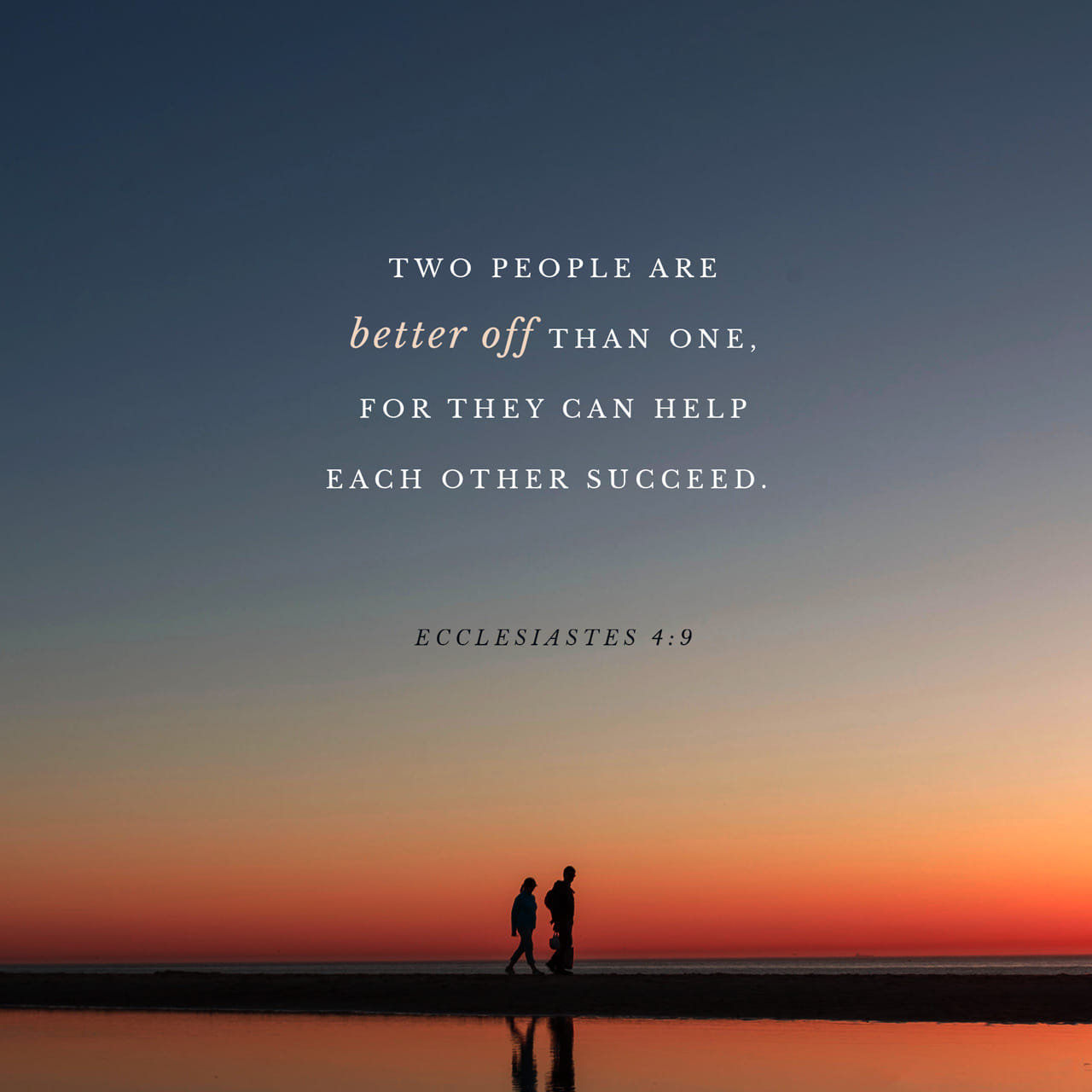
“Two are better than one…if they fall, one will lift up the other…”
How ironic it is that me, a pastor, who has spent a career lifting others up, was so reticent to let others lift me up. But I suspect I’m not nearly alone in that. Many of us, pastors or not, are much more comfortable with the idea of lifting others up than allowing others to lift us up. There’s a humility required to allow others to lift us up, to admit we’re struggling, to come out of our solitary lives. Human nature, it seems, tends toward solitary living, lying to us that we’re self-reliant. That’s part of our broken human nature. It’s true for all of us. And to come out and humbly ask for help when struggling, in body, mind, or spirit, is uncomfortable. Humility, and going against our human nature, are always uncomfortable.
But it’s so necessary. People have asked me how I got through. How I made it through this terrible bout of illness. My answer is the love and support I felt from all my friends, family, and church, which is itself a mirror reflection of the love and support of God. And that makes all the difference. Once I reached out for support after Lynette texted me on December 7, I rarely wavered in hope. My emotional and spiritual health was good. My attitude stayed rather sunny. I had hard moments, like finding out I had mild heart failure, but most of the time, I was hopeful.
In the end, I had two strains of antibiotic-resistant bacteria in my sinuses, or basically dual sinus infections, that’d I’d been carrying since early October. This explained why the oral antibiotics I took throughout the fall were only partially effective. I required IV antibiotics to defeat these two strains, but we didn’t know that until I was in the hospital in mid-December. Those strains migrated to my chest in November, probably aided by whatever I had picked up on the plane back from Pennsylvania, leading to bronchitis the week before Thanksgiving. I now can see that I did the Interfaith Thanksgiving Service and led this church’s services in November with bronchitis. By the time I got back from celebrating Thanksgiving, I had pneumonia. By the time I got to the hospital, I had all this plus I’d also picked up RSV, which with my asthma, is a very challenging illness.
The combination of infections, along with all the medicines I’d been taking, had also impacted my organ function. Of course, my asthma made all of those things worse, as if they weren’t enough on their own. Asthma, and some bad luck in getting those antibiotic-resistant strains of infection, is an answer to how I got so sick. I continue to see doctors, seeking additional information, as I continue this long road of recovery.
I still have a long way to go. My energy level isn’t nearly what I’m used to. My stomach is bad. There are a few things that are still concerning about my health that we’re working on. Adjusting to work has been both joyful and hard physically. I promise, I’m taking it slow. And let me tell you how grateful I am that I know wanting me to take it slow would be your first reaction as a congregation.
Whatever’s in front of me as I walk this journey, I don’t do so alone. I walk the journey with my friends. I walk the journey with my family. I will not live such a solitary life again. I will let people in sooner. I will talk more about my struggles. I will take better care of myself by not living a solitary, self-reliant, lifestyle.
Our human nature tends us toward solitary living. We tend, like me, to downplay our struggles and not reach out for support. But my experience has shown me the wisdom of Qoheleth’s words: two are definitely better than one.
God created us to for companionship. When God created Adam, God declared it was not good for him to be alone, and created Eve. When God called Moses, he also called Aaron and Miriam to be supports for him. When God called David, he gave him a close friend in Jonathan who saw him through David’s hardships. When Mary received the news she was pregnant, the angel sent her to her cousin Elizabeth, for both of them to not be alone in their remarkable journeys. When Jesus sent the disciples into villages, he sent them two by two. And later, when Jesus commends prayer, he notes, “where two are three are gathered, there I am with them.” In Acts, the first thing the disciples do after Jesus ascends is to select a replacement for Judas. When they begin their ministries, they form communities of support. Even Paul, whom we often discuss as an individual, always had fellow travelers with him, always had other apostles to whom he could turn. Consider the books of the Bible he wrote are either to individual friends like Timothy and Titus, who walked the journey with him, or are to groups of friends, house churches, in places like Corinth, Thessalonika, and Ephesus. We were never meant to be alone. We were never meant to live solitary lives. Two are better than one.
And then, three are even better. Note that the scripture follows this pattern: one, two, three. Qoheleth condemns solitary living, declares that two are better than one, and then finishes with a famous verse, “A threefold cord is not quickly broken.” When we choose to live life with others, when we reach out for support, when we ask for help, when we confess our struggles; when we do the uncomfortable thing and choose humility to say that we cannot do it alone, we find the support and love of our friends. And in that support and love, we experience God’s support and love. That’s the third cord. God is with us in the community we build with our friends and family. God’s love comes through. God is present. The love and support of our friends is a mirror reflection of God’s love and support. The support and love of friends brings with it the support and love of God. Indeed, a threefold cord is not quickly broken.
I wonder, who are the people in your life who give you support? Through whom do you experience the love and support of God when you reach out with your struggles? This is the primary thing Sunday School classes and small groups provide. It’s the primary thing families are built for, and we as families learn how to give each other support at church. Because God designed the church to support one another during hardship.
I also wonder, when struggles come and life gets hard, do you reach out for support? Or are you like I was, telling yourself you can figure it out, you can make it work, you don’t need help, it’s too embarrassing to ask for anyway, and you’ll just double down on yourself? That is an unhappy business, it leads to consuming our own flesh, literally cannibalizing ourselves, as we eat away from the inside out because we won’t ask for help. Whatever your struggles, in body mind, or spirit, God made us to bear those burdens with others, to share together in the journey, for when we do so, we experience the love and support of God.
Lying in that hospital bed on that Monday, Dana reached over from her chair and said, “you need to check your email.” There, among all the junk emails we all get, was a surprising, deeply moving, gift. Terre had composed a hymn for me. We all process hardships in our own ways and Terre explained in the body of the email that his way of processing his empathy for me, and of sharing his love for me, was to write me a hymn. I read it over and over again. It’s soon to be framed in my office and we’re going to sing it together to close this service.
In that hymn was God’s love and support, brought through in powerful fashion by the love and support of a friend. Two are better than one. A threefold cord is not quickly broken. God’s love and support comes through when we share life together with friends and family.
We need each other. We were not meant to live solitary lives. We must give up the solitary, self-reliant, lifestyles of deciding we can do it on our own, that we don’t need help, that it’s too embarrassing to reach out for help, that we can figure things out on our own. I have learned that such is vanity, a chasing after the wind, and leads to consuming myself. We need friends. We need family. We need church. We were built for them. God made us for them. And through them, we experience the love and support of God.
Whenever hardship comes, reach out for help from friends, family, and the church. There, you will meet the love and support of God. Indeed, two are better than one, and a threefold cord is not quickly broken.
In the name of the Father, Son, and Holy Spirit; Amen.
 Ted Goshorn