Why do you love Thanksgiving so much?
That’s the question I got the other day. Because, I really do. I love Thanksgiving. I’m so excited about Thursday. But really, I’m also excited about tomorrow, when the families of my S3 group will gather together for a Thanksgiving meal. I’m also excited about going to our cabin and having friends join us for the remainder of the week as we celebrate together.
I’m even kind of thankful that Thanksgiving is increasingly overshadowed by Christmas. It seems the Christmas season starts somewhere around October 20th. So, by that measure, I suppose we’re approaching the halfway point of that season. But it means that Thanksgiving retains a sort of purity in my mind; less corrupted by forces of commercialism.
I love Thanksgiving. What do you love about Thanksgiving? Or, perhaps, you feel the opposite of me. What is it about Thanksgiving that leaves you feeling that way?
In our Psalm this morning, the Israelites are giving thanks. In fact, they give thanks specifically 27 times. And we’re going to do the same. Let’s stand together as we read Psalm 136 responsively. You’ll say the repeated refrain, which is every other line beginning with the second. The refrain is printed in your bulletin.
I have many fond, warm, memories of Thanksgivings gone by. Perhaps you do, too. Bring to mind those memories, of gathering together, of family and dear friends. Every Thanksgiving, I find reason to say with our Psalm this morning, “Give thanks to the LORD for he is good, [God’s] steadfast love endures forever.” And I imagine, that holds true for all of us gathered in this room; we all have reason to give thanks to God.
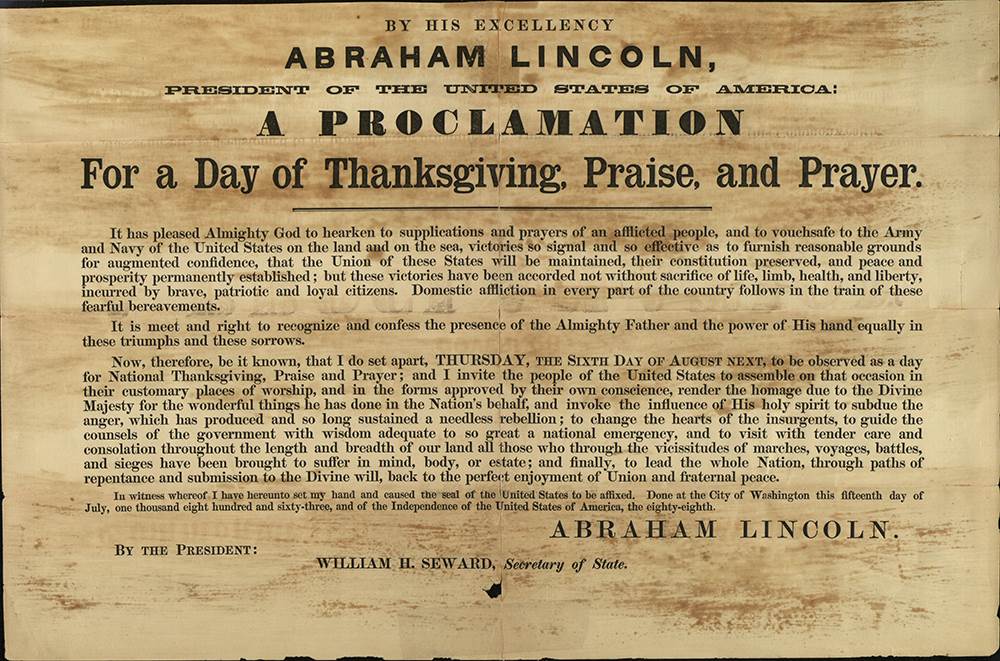
Such was also true for the author who penned these words, “The year that is drawing towards its close, has been filled with the blessings of fruitful fields and healthful skies.” Those are Abraham Lincoln’s words, writing his Thanksgiving Proclamation in 1863. He continues by thanking God for the manifold blessings the country is experiencing. Beautiful words, but let us consider what had happened in the months leading up to this 1863 proclamation.
The battle of Gettysburg was fresh in the minds of the people. The union had won the battle, but at a tremendous cost. A reorganization of the Union armies hadn’t produced the results hoped for, and the people had little hope of anything except a continued long, costly, brutal, war. In 1863, the people just knew death, destruction, and desolation at their doorstep. And in that year, Lincoln continued his suspension of the constitutional right of Habeas Corpus and issued a draft, the first in the history of the country, causing riots across the northeast.
Henry Wadsworth Longfellow, American poet of fame, writing that same year and reflecting on the reality of death, destruction, and desolation, penned these words, “Then from each black accursed mouth, the cannon thundered in the south, and with their sound, the carols drowned, of peace on earth, goodwill to men.” He could speak from personal experience. His son, Charles Appleton Longfellow, had joined the union army against his father’s express wishes. In November, 1863, he was severely wounded. And so Longfellow continues, “And in despair, I bowed my head. There is no peace on earth, I said, for hate is strong, and mocks the song, of peace on earth, goodwill to men.”
This was the reality for the country in 1863. And yet, Lincoln writes that the year, “has been filled with the blessings of fruitful fields and healthful skies.” How can he say that, knowing the destruction and devastation? The loss of constitutional rights and the expansion of executive power? The death that touched nearly every family across the United States?
There are parallels to our own time. We have come through the pandemic, but we are still living with the global upheaval it caused. We have witnessed wars in the Ukraine and Israel, enough devastation and destruction on their own, and then worried that these conflicts might lead to regional or even global conflicts.
Then, we must consider the rise in hate. Anti-semitic activity has shown a sharp increase year over year, according to the FBI. That coincides with an increase in race-based violence across the country and the world. When we talk about being increasingly divided as a nation, too often we’re talking about the increase in hate among different groups. How do we give thanks, how do we proclaim that God’s steadfast love endures forever, with hate on the rise? With wars around the world. With the threats and challenges we currently know?
Proclaiming, “give thanks to the LORD for he is good, God’s steadfast love endures forever,” can feel challenging when, in Longfellow’s words, it seems that “hate is strong and mocks the song of peace on earth, goodwill to men.”
Perhaps Longfellow understood the times better than Lincoln. Was Lincoln delusional with his words? The rest of Lincoln’s 1863 Thanksgiving Proclamation makes some mention of the war, but generally gives thanks to God for all that the country is, in his word, “enjoying.” How could Lincoln write such a thing? What is there to enjoy during a period of destruction, desolation, and hate?
Could we, ourselves, utter such words today, mindful of the trouble we know?
I have had troubling Thanksgivings of my own. During one particularly tough Thanksgiving a few years ago, I felt beset from every side, saw no way forward through the sheer conflict and trouble I knew at the time. My Thanksgiving that year was full of fear, worry, as I gazed upon the desolation and destruction I knew in my life. Perhaps you’ve known Thanksgivings like that. Maybe you’ve entered into a Thanksgiving with lots of fear and worry because of what’s happening outside of your family. Maybe it’s the gathering together with family that led to a hard and fraught Thanksgiving. How do we give thanks when Thanksgivings go wrong, or when life gives us little to no reason to give thanks?
I brought that question with me to church during that season of life. And there, we sang these words, words that we will sing together in our final hymn this morning:
Ponder anew, what the Almighty can do.
And those words said to me, in the midst of my trouble, “God’s not done with you yet, Ted. Give thanks to the LORD, for he is good; his steadfast love endures forever.” And I knew, at that moment, God would redeem my troubles, turning the turmoil I knew into good.
And today, I stand before you and say God redeemed me from my trouble, and while I would not want to repeat it, I give thanks for how I have seen God move in redemption power in my life; how I know that God’s steadfast love does indeed endure forever.
It seems, the best way to know that God’s steadfast love endures forever is to see how God’s steadfast love has endured forever in our pasts. It’s to look back and see how God brought us through times of trouble, to the other side. When we do so, we gain the imagination to ponder anew what the Almighty can do, for we can see how God has brought us through times of conflict and division, times of desolation and destruction, times of hopelessness and despair.
Our Psalm this morning records just that. Consider verses 10 through 22. They recount Israel’s history; the way they have seen God deliver and provide for them. They recount times of war, times of hardship, times of slavery, times of despair and want and fear. They do not hold back in recounting the challenging parts of their history. But with each recounting, they echo that repeated refrain, “for God’s steadfast love endures forever.” They can look back in their past and see how God has provided, how God has delivered, how God has been present through their suffering. And in looking back, they can see how God’s steadfast love brought them through. That’s what powers their ability to believe that God will always provide; they can ponder anew what the Almighty can do, by seeing how God has always provided for them.
That was reason for Thanksgiving.
For us today, it can be reason for thanksgiving, too.
This past Annual Conference, I was asked to help lead prayer moments. During a season where we were still reeling from the loss of friends and churches we’d known for years, I turned to this Psalm to help us move forward. I subbed the history of our conference in verses 10 through 22, just as your worksheet shows. Together, we gave God thanks for the way God has been with us throughout the history of our Annual Conference; a history that began here at Mulberry in 1831 with the founding of the Georgia Conference, and a history that includes times of hardship, including this particular moment. But, together, both in joys and sorrows, we proclaimed that God’s steadfast love endures forever, so we could ponder anew what the Almighty can do during this season of loss.
And certainly, this holds true for us as a church. From the founding of the Georgia Conference in our sanctuary, which dubbed us the Mother Church of Georgia Methodism, to the founding of the South Georgia Conference in 1866, to our role in founding Wesleyan College, and the role we have played in this community since 1826, we have known God’s steadfast love. But we have also known God’s steadfast love through the near split of the church in 1890, through the great fire of 1965, through the 10 different pastorates between 2007 and 2022, through loss and contraction. And today, we know God’s steadfast love as we see renewal and forward momentum. Through it all, we can look back and see how God has delivered, provided, made a path; how God’s steadfast love has endured for us as a church. And that leads us to be able to ponder anew what the Almighty can do during our current season of renewal.
Think back in your life. When has God redeemed you from trouble? When has God provided? Where can you see how God’s steadfast love has endured forever for you?
Whatever you see, let us give thanks this morning. Let us consider how God’s steadfast love has brought us through whatever trials and tribulations we may have known in recent years; the desolation, destruction, fear, and death we may have witnessed and experienced ourselves. Consider that alongside of the joys and highs of life; the blessings we have also experienced over the course of the year. How has God redeemed you, brought you to the other side, provided for you, where you can then exclaim, “I give thanks to the LORD for he is good; God’s steadfast love endures forever?”
This is the point of the worksheet provided with your bulletin. It’s a chance for you, as a family or with whomever gathers around your Thanksgiving table, to recount your history. Where have you known God’s deliverance? God’s steadfast love? What challenges and hardships have you known? And how have you seen God provide? When you hear the words, “God’s steadfast love endures forever” what comes to mind? And if you have trouble answering the question, if life has been hard, hear the words again from that hymn, “ponder anew what the Almighty can do.” God has moved in power, providing for you and your family even through the tough times, but it may take some thinking, some conversation, some pondering, to see what God has and is doing for you and your family.
Record what you find there, on that worksheet. This can be a great way of praying together, of stimulating conversation around the Thanksgiving table. As you gather, say how God’s steadfast love has endured through your family and friendships forever. Together, just as the Israelites who first wrote this Psalm, you are recounting your history and showing how God’s steadfast love has endured forever for you and your kin.
That’s been my history. This is why I love Thanksgiving so much. It’s an annual chance to reflect, to see where God has moved through the good and especially the bad, so that I may say afresh and anew, God’s steadfast love endures forever. It’s an opportunity to ponder what the Almighty can do, so that no matter what happens between now and next Thanksgiving, we can be assured and rest our faith in that oft-repeated phrase, God’s steadfast love endures forever.
It seems Lincoln knew that reality; that God’s steadfast love redeems our troubles. He believed that God would provide, God would take care, and so it was good and right and true to give God thanks in the midst of devastation, destruction, fear, and death, of 1863 because he knew God wasn’t done with him yet. God wasn’t done with the United States of America yet. So he could give thanks to God despite the troubles that enmeshed, enveloped, enjoined, and enraptured. He could say, “Give thanks to the LORD, for he is good; God’s steadfast love endures forever.”
And, even with his son severely wounded, knowing the devastation and destruction of the Civil War, Longfellow pondered anew what the Almighty can do. After saying in his famous poem, “and in despair I bowed my head, there is no peace on earth, I said, for hate is strong and mocks the song, of peace on earth, goodwill to men,” the very next stanza says this:
“Then peeled the bells more loud and deep. God is not dead, nor doth he sleep. The wrong shall fail, the right prevail, with peace on earth, goodwill to men.”
Longfellow knew: we are God’s people, the sheep of his pasture. God will prevail. The wrong shall fail. The trouble we know now, it will not be forever. God will provide. God will redeem. And we, on the other side, will say with Psalm 136, “O Give thanks to the LORD, for he is good, his steadfast love endures forever.”
In the name of the Father, Son, and Holy Spirit, Amen.
 Ted Goshorn