Robert Wadlow was known as the Giant of Illinois.
Born in 1918, he grew to be the tallest man who ever lived. At least, the tallest we can confirm. Because of a disease of his pituitary gland that was, at the time, incurable, he produced massive amounts of the human growth hormone. That caused his body to grow to the astounding height of eight feet eleven inches.
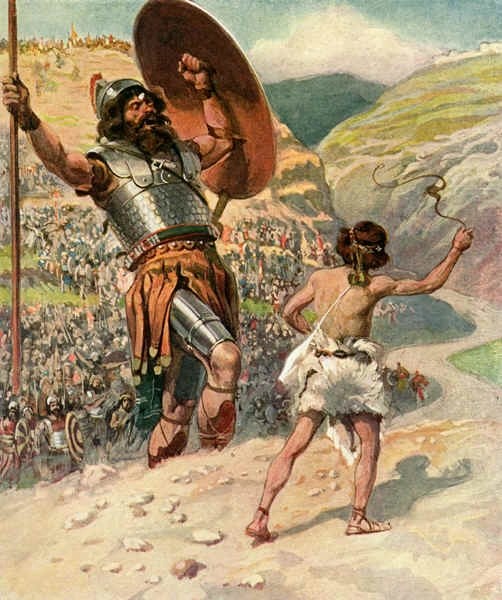
By some accounts, Goliath was even larger. He stood, according to scripture, at six cubits and a span. There’s some disagreement about how tall exactly that is because there’s disagreement about just how long a cubit was. But, we can say Goliath was at least six feet, seven inches. Exactly Payton’s height. Still tall; especially considering that humans were generally shorter in his day than they are today. But, by some accounts, he was as tall as nine feet, nine inches.
His compatriots, the Philistine Army, stand behind this giant, ready to go to battle. Across the valley, the Israelite army sits encamped, too, ready for battle. Goliath comes out and not only challenges them, but taunts them in a way that evokes fear from King Saul and the Israelites.
Let’s hear part of that story from 1 Samuel.
“When Saul and all Israel heard these words of the Philistine, they were dismayed and greatly afraid.”
And rightly so. Goliath is more than just a giant. They have three big reasons to be dismayed and greatly afraid of him.
First, Goliath is huge. We’ve already noted his height; tall for our time and even more so for his time when people simply did not grow as tall as we do. But not only this, scripture notes that he’s a champion; a Hebrew word that literally means he stands between. He can stand between two men and not be taken down. He’s a battle-hardened warrior; probably with big muscles and the intimidating stance and presence that any champion warrior would have. Goliath is huge.
Second, he’s overwhelming. The scripture goes to great lengths to describe his armor. It’s the best the Israelites have ever seen and probably represents some technology they didn’t have. This would be intimidating enough. What armor will the Israelites use against him? What weapons? They’re overwhelmed by the challenge. Not only that, but when he says “Today, I defy the ranks of Israel,” he’s insulting them. He’s saying “today I disgrace, I shame, I spit on the ranks of Israel.” He’s so confident in himself that he believes there is no defeating him. This is a psychological victory for the very next verse indicates that King Saul and all of Israel are indeed intimidated by this disgrace, this shame. They cannot stand against him. Goliath is overwhelming.
Third, the stakes are high. In the ancient world of Saul and Goliath, a single fight between two warriors would sometimes determine the outcome of an entire battle. In Goliath’s challenge, there’s more than just egos involved. Should Goliath win against Israel’s best warrior, all of Israel could be defeated and thus become servants of the Philistines. At a very minimum, Goliath’s victory would give a huge psychological advantage to the Philistine army ahead of the ensuing battle between both nation’s armies. The stakes are very high.
Goliath is more than just a giant. In this moment, the Israelite army in confronting Goliath is facing a huge, overwhelming, high stakes challenge.
It’s no wonder that “Saul and all Israel…were dismayed and greatly afraid.” It’s only human to react in just that way in the face of such a challenge. It’s only human to react with fear.
And isn’t that the case whenever we face serious challenges? Confronted with some huge, overwhelming, and high stakes challenge, don’t we also become dismayed and greatly afraid?
Certainly, we do. We can relate to Saul and all of Israel as they face down this giant whose challenge is huge, overwhelming and high stakes, for we have known Goliaths of our own huge, overwhelming, high stakes challenges; challenges like
A terrible diagnosis, perhaps of cancer or some other disease.
A close relationship with a friend or family member that is failing and seems inevitably headed for separation.
A family conflict that threatens to turn legal. Or a family conflict that results in hurt and broken relationships.
A financial loss that threatens the foundation of our families or businesses or institutions we love and support.
A sin or action we’ve taken that’s caused others to look at us differently, poorly, threatening our sense of self and our sense of stability.
Or perhaps an internal wrestling we keep that we dare not tell others, lest they think poorly of us, but still the secret destroys us internally.
All of these are huge, overwhelming, high stakes, challenges. They often elicit fear.
What are we to do in the face of those challenges?
Put another way, when Goliaths appear in our lives, how should we respond?
There are some seasons of life where the challenges build and, all together, seem overwhelming. I’ve spoken before about the deep anxiety I felt a few months ago. As that was receding, Dana had her surgery with its challenges. Then, we had a friend who was living with cancer suddenly get very sick, decline rapidly, and pass away at the end of September. At the same time, I labored to run our stewardship campaign, add additional household duties while Dana recovered, and deal with my own emotional and psychological weariness. For about three months, I had quite a season of stress. As the challenges built, they increasing felt like Goliath: huge, overwhelming, and high stakes.
Goliaths appear for all of us. I have faced my own recently. When those Goliaths appear, when we face huge, overwhelming, high stakes challenges, how are we to respond?
First, we should respond like Saul and the Israelites, with dismay and fear.
If we don’t, we’re not human. Those emotions are not wrong and, indeed, they’re useful from a psychological perspective. They help us process and they activate parts of our brain that keep us safe.
Sometimes when we’re facing these kinds of huge, overwhelming, high stakes challenges, we hear that Christians are somehow not supposed to react with fear and dismay, that somehow we’re just supposed to shrug our shoulders or stand resolute, unmoved by our cancer diagnosis, failing family relationships, threat of financial ruin, or some problem deep in our soul. Or when the things of life just build and life feels huge, overwhelming, and high stakes like it did for me recently, we’re somehow supposed to have a stiff upper lip as Christians and not experience these very human emotions of dismay and fear.
But this is simply not true. God designed us to have these emotions as part of our fight or flight response. We should feel those things. We should respond in that way when these huge, overwhelming, high stakes challenges appear in our lives.
So the question is not whether we should experience fear. We should and we do and we will. The question is whether or not the fear defines us. When we face huge, overwhelming, high stakes challenges, do we allow fear to have the last word?
That’s the issue for Saul and all Israel. Fear defined Saul. In response to the challenge of Goliath, he went into his tent and sulked. We can imagine him wringing his hands in dismay, desperate for a solution but believing none exists. All the Israelites ran in fear back to their tents after catching sight of Goliath, saying to one another “have you seen him?” with much fear and trembling.
And that’s how they stay. In a state of fear. And that’s what fear does when it defines us: it immobilizes, it causes us to sulk in self-pity. Fear can be, on its own, huge, overwhelming, and high stakes. Sometimes the fear becomes worse than the challenge itself, as it blinds us to solutions and blinds us to how God is moving in power around us.
We will first react with fear whenever a huge, overwhelming, high stakes challenge confronts us. That’s just human and how God designed us.
But then, we have a choice about whether or not the fear will define us.
As the Goliath story progresses, we discover that David, a boy of little regard and reputation, is the solution. God has provided a way out for the Israelites. David slays the giant. Then, flush with the psychological victory, the Israelite army rushes forward and carries the day in battle.
Sometimes, we get to see God move in power like that. Our faith proclaims that God will deliver us just as God delivered the Israelites. It’s easy to look back and say how we saw God move in power after God has delivered us from our huge, overwhelming, high stakes challenges. Certainly, that’s what God does. I can look back over the last few months and see how God was moving in power through close relationships in my life and by providing necessary time away to recover. That hindsight fuels our faith: we know that if God has before, God can do it again.
But life is at its toughest when fear is present, when we face those huge, overwhelming, high stakes challenges and don’t know what to do next. While we’re in fear, we have no idea what that deliverance will look like. So what do we do while we’re waiting for that deliverance? Because it sure can feel like it takes a long time before God delivers, especially when fear is present.
This is especially true when the challenges we face are like how we’ve described Goliath: huge, overwhelming, and high stakes. Those terrible health diagnoses, especially the ones that seem terminal; the failing familial relationships, especially those failing marriage relationships; the awful financial downturns that can affect those we love or even institutions we love; the loss of reputation in town or the secrets we keep that eat us up from the inside; all of those and more can invoke tons of fear and leave us feeling helpless and hapless, defined by our fear.
When our Goliaths stand before us and seem immoveable. What do we do while we are waiting for God to deliver us from our Goliaths; from our huge, overwhelming, high stakes challenges?
It’s incredibly difficult to wait for deliverance and not be defined by fear. It’s incredibly difficult to not be Saul in this story; immobilized and distraught, defined by his dismay and fear. We all know this because all of us know what it’s like to face a huge, overwhelming, and high stakes challenge that evokes tons of fear.
But that fear need not define. This story points our way to discovering freedom from fear.
Note that Saul and the Israelites stayed focused on their fear. They simply kept looking at their fear, being immobilized by it, refusing to pray or seek God’s wisdom or otherwise turn to God.
In his speech, Goliath calls the Israelites, “servants of Saul.” That should strike us as odd. The Israelites were never to be servants of a king. God rescued them from being servants to a king named pharaoh so that they could be servants of God!
But they are acting like servants of Saul. In David’s speech to Saul later in this chapter, David repeatedly calls on God’s name, the first time God is mentioned in this story at all.
The lack of mention of God shows how Saul and David are focused differently. Saul is focused on his fear. David is focused on God.
And that difference in focus makes all the difference. In the midst of our fear, we must choose to focus on God instead of our fear. It will be very difficult, but focusing on God instead of our fear is how we discover freedom from fear while we await God’s deliverance.
We will all face huge, overwhelming, high stakes challenges from time to time. Those health diagnoses, failing familial relationships, family disputes, internal threats, money troubles, will hit all of us or those we love. They happen. And our initial response will be fear, as it should be.
But then, we must choose to focus on God instead of succumbing the temptation to focus on our fears.
How do we focus on God in the midst of our fear? What do we do while we’re waiting for God’s deliverance from our Goliaths?
This morning, we’ve defined our Goliath’s as huge, overwhelming, and high stakes. Focusing on God over fear, as we await God’s faithful to deliverance, is to engage with God in three ways, the opposites of huge, overwhelming, and high stakes. We do a small thing, we get simple, and we practice humility.
First, when huge challenges arise, do a small thing and pray. Prayer is about mindset as much as it is being with God; it keeps us focused on God, it keeps us grounded in God. There are many ways to pray. Come and chat with me or Payton if you need help getting started or finding a new way to pray. We have resources, including the appendices in my book. Prayer can seem like a small thing, but it helps grant us perspective on our huge challenges.
Second, when overwhelming challenges arise, get simple. Do the things God has called you to do. Love on your family. Serve on your boards and here at the church. Serve others. Focus on the things that bring you joy. Exercise. Focus on the basic things of life. It’s like we’ve defined Christian simplicity all along: be yourself and trust God with the rest. Focusing on the simple things of life helps cut through the way fear can overwhelm to keep us grounded.
Third, when the stakes are high, practice humility: get right with God. This will require confessing sins, it will require reengaging with God if we’ve been negligent in our relationship. It will be hard, no fun work. But at the end, we will know this: we belong to God. God will provide. And we will experience the height of God’s love that is higher than any stakes we know. Practicing humility reminds us, too, that ultimately it’s up to God to fix and restore; we cannot deliver ourselves. That reliance and trust in God will see us through.
When Goliaths appear in our lives, huge, overwhelming, high stakes challenges, pray, practice simplicity, and get right with God.
Fear will come. We will all experience it. And fear is terrible. It’s hard. It on its own is huge, overwhelming, and high stakes. Fear can be it’s own Goliath.
But no matter the giants you face, the fear doesn’t have to define. In the face of fear, pray, practice simplicity, and get right with God. Focus on God in the face of your Goliaths.
In the name of the Father, Son, and Holy Spirit; Amen.
 Ted Goshorn