I once met a man on the streets who had a fire in his eyes. He presented as very different from me but we met up on the sidewalk in a way that caused us to interact. I admit, years ago, I was much less likely to engage with someone who looked like they lived on the street; I was much more likely to be inhospitable.
But as we got to talking, he shared his story with me. He’d just gotten out of prison; a common story as many of us know from our experiences talking with folks. But then the story took a turn. He told me his sentence had been commuted; he’d been released from death row. With that same fire burning in his eyes, he told me of how God had forgiven him, how God had redeemed him, and how he was nothing but grateful. He burst into tears.
Part of me wanted to be skeptical; I’ve heard a few sob stories in my day trying to manipulate me into giving. But quickly I chided myself for being so jaded. I responded that his story was powerful; I empathized with him, I touched his arm gently. We had a powerful moment, and then he walked off.
This man needed a moment for someone to hear his story, to share in his story, and to affirm him. He needed someone to share in his gratitude. He just needed someone to be hospitable for a moment.
That’s the power of being hospitable: when we demonstrate hospitality, we share the love of God.
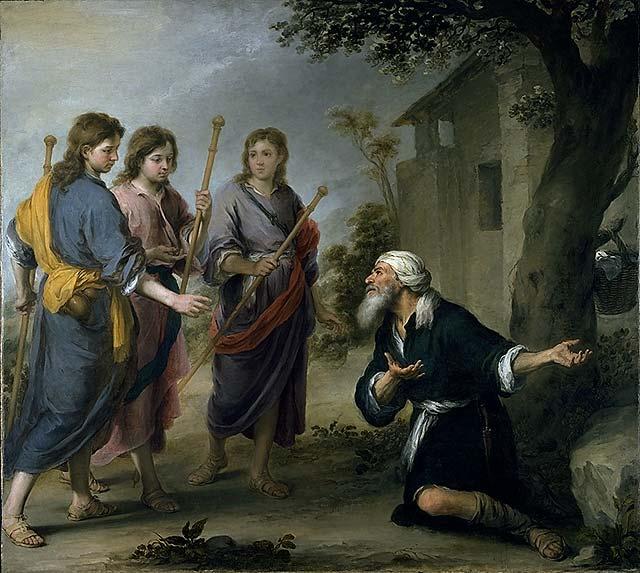
Let’s hear a story of remarkable hospitality by Abraham from Genesis 18:
Imagine with me that three folks you don’t know come walking down your driveway. You don’t know them at all, and they’re clearly there to visit you. They’re dressed normally enough so nothing about their appearance gives you cause for concern at first glance. But they move with purpose, toward your door, bags on their shoulders, clearly a people who have been doing some traveling.
How do you respond?
My first instinct would be to think they’re Mormons or Jehovah’s Witnesses. I’d more than likely try to hide, turning off lights, shutting blinds, wanting to communicate that no one is available and, hoping that they assume no one is home.
What would your first instinct be?
My guess is none of us in this room would act like Abraham.
Abraham runs to meet them and then throws a feast. There’s a flurry of actively as Abraham moves to welcome the guests. Consider all the action verbs in these verses. Abraham looked up, saw, ran, met, bowed, brought, brings, refreshes, makes ready, took, and prepares. He moves quickly to welcome these travelers as honored guests.
Now we the reader know that this is God, come down in human form, with two angelic hosts; perhaps a prefiguring of the Trinity. We know that Abraham is playing host to God himself. But Abraham doesn’t know that. All he knows are three travelers have come to visit him. All he knows is that his duty is to be welcoming.
In the modern Middle East, such a culture of hospitality remains. There’s great honor involved in being hospitable and there’s great dishonor in being inhospitable. Some of Abraham’s reaction is perhaps lost to us because of those cultural differences.
But there’s something greater here, something regardless of cultural differences, something for us in how Abraham is hospitable.
Consider the money Abraham is spending. He’s not a rich man. He lives a nomadic existence, like many of his contemporaries. He lives off the land. The bread he serves requires expensive oil. The calf he slaughters and has prepared costs a small fortune. Abraham and his contemporaries ate a diet very light on meat; to eat most meals as a vegetarian, high in grains, was common. Abraham is spending a good bit of money on people he doesn’t know.
Then, consider the risk that Abraham is taking. He doesn’t know these men. In the nomadic existence of his time, robbers were common. Men would pose as fellow weary travelers, only to rob you blind. Worse things happened, too, where travelers would show up and take advantage of your hospitality by taking advantage of others in your household in ways that did great harm. Violence was common in Abraham’s time; far more common than it is for us today.
So there’s great risk being assumed by Abraham: risk to his household finances and safety. And yet, he chooses hospitality anyway.
Why?
On the last Sunday of May, just a few months ago, I met Jesse.
I was standing, chatting with a few of you in the atrium that Sunday morning, when he came in with a fellow member of our church. I learned he was hungry, living on the streets, and in need of help. He also looked the part: worn and weary, tired and dirty, someone who almost certainly lives on the streets and experiences homelessness. I went back and forth to the kitchen, grabbing what I could find, to offer him some food and assistance. But what I witnessed in between is what amazes me.
As many of you walked in that morning, you greeted him and invited him to Sunday School and to worship. You introduced yourself. You brought him coffee and donuts. You treated him as an equal, you treated him as a fellow image of God.
In a word, we as a church were hospitable. And in doing so, we shared the love of God.
That’s the why. Why would Abraham act as he did? Why should we follow his example? Because in doing so, we share the love of God.
Many people walk around us in need of some love; just someone to regard them as an equal, to share in their lives for a moment, to let them know that they are heard. When I studied counseling, I learned the most important thing is to validate the client: let them know they’re heard, they’re appreciated, they’re safe, in that counseling space. Demonstrate that what they have to say matters and that you care. I think that’s true for all of us humans. Especially if we’ve lived an existence where we’ve known rejection in any of its forms: by a workplace, by society, by parents, by the church, by a spouse, by children; in any of a number of ways; we all need validation. And we receive validation first through hospitality, because hospitality is an expression of God’s love.
It seems a small thing, but sharing the love of God by simply being hospitable has the potential to make a powerful difference. When the person seems very different, or is a stranger, or shows up unexpectedly, it can feel like there’s some risk involved. But Abraham shows us, it’s worth taking the risk; it’s vital to take the risk.
When we practice hospitality, we offer the healing presence of Christ; binding up the wounds caused by past rejections. Every opportunity to be hospitable is an opportunity to show the love of God to someone who needs it. Like Jesse.
I’ve seen this church react in such hospitable ways many times: in worship, when we’re gathered together for an event, through Macon Outreach. As a staff, we’re practicing this hospitality through the commitment we’ve made to eat lunch at Macon Outreach on Wednesdays.
What we do through our hospitality is treat others as if they were our friends; treat others with love and affection regardless of how different they may seem. We follow the golden rule: treat others as you yourself want to be treated.
That’s sharing the love of God. And it provides healing for the broken places of life. A little act of sharing the love of God goes a long way.
Today’s focus for stewardship is service. We start here, with hospitality, because hospitality is the beginning of all service. Before we can help someone, before we can offer ourselves in outreach, we must first welcome the stranger, be kind to those who seem very different, offer an invitation to those who might be out of place.
We did that when we welcomed the community for the service for the Temple back in July. We do that every day when we open the doors of Macon Outreach. We even do that through the children’s center, where children are learning how to be social with each other. They’re learning in an environment of love and faith; one that will leave an indelible mark on their lives as they grow.
We do this as a church through a variety of ways. When we come to worship, we experience the love of God that transforms. When we engage in a regular small group or Sunday School class, through fellowship and the bonds of friendship we grow in our ability to be welcoming, invitational, and loving. We worship and grow so that we can go and be of service to God.
And when we give to the church, we support this church’s ability to reach out in love and service. Very purposefully, when Macon Outreach and the Children’s Center were formed, they were not made responsible for all their costs. The fact that the church pays for the heating and cooling of spaces, for the upkeep of facilities, and other basics means that Macon Outreach can put more of its funds toward feeding and clothing our friends and neighbors who are in need. It means that our Children’s Center can operate at a lower teacher to student ratio, further developing the children in our care. We work together through our various ministries to meet the needs of those around us.
When you give regularly to the church, you support our efforts to bring the little children to the Kingdom of God, to clothe the naked, to feed the hungry, and to welcome the stranger. In all these ways, we show the love of God.
We are not your average church; we are part of the fabric of the downtown community. We support those who cannot support themselves. We share the love of God in very tangible ways. And in our attitudes and dispositions, in how we relate to all who walk through our doors on a Sunday morning, we demonstrate that love lives here. We demonstrate that we are healers.
We are a hospitable church. It’s one of the ways God has gifted us. And as we take the risks involved and live that out, welcoming people into our church regardless of how alike or different they may seem, we foster healing for the broken places of their lives. Through our hospitality, we offer healing for people’s relationship with the church, bringing folks back in and perhaps offering a home for new folks.
Can you support our efforts? If you haven’t already, please return your pledge card and let us know how you plan to regularly support our ministry. Also considering engaging in service opportunities here at the church. There’s a survey linked in your bulletin. Let us know how you’d like to serve through the church. The Children’s Center needs room parents. You could join the staff on Wednesdays and eat with our friends and neighbors at Macon Outreach. There are even more options listed on the survey. Complete the survey, return your pledge card, and further the healing mission of Mulberry Street United Methodist Church.
Hospitality has huge payoffs as we share the love of God through welcoming strangers as equals. That’s the example Abraham sets for us. That’s the example we often live into. I’m grateful that we are such a hospitable church. Through our hospitality, through our risk taking that’s involved, we share the heart of God from the heart of downtown Macon. Through our hospitality, through our risk taking, we foster healing for the broken places of life.
In the name of the Father, Son, and Holy Spirit; Amen.
 Ted Goshorn