Just outside of Albuquerque is the Petroglyphs National Monument. We’d come to see drawings made on the side of rocks by inhabitants of the land long ago. At this point, we had yet to see drawings but were enjoying the sunshine and the terrific views of Albuquerque from this park. As we turned down the path, we saw, scattered around the sides of the path, stones stacked one on top of the other. They were small, maybe six inches to a foot high, and definitely human-made: little stone monuments or, as Carter yelled it for all to hear: ebenezers!
We might be mostly familiar with the word ebenezer from Charles Dickens’ classic, “A Christmas Carol.” Part of Dickens’ brilliance in that book is naming the main character Ebenezer. That word, in Hebrew, means “stone of hope.” And isn’t Ebenezer Scrooge a stone of hope?!
In the book of 1 Samuel, the prophet Samuel stacks stones on top of each other and calls it an ebenezer; a marker of the hope he had in God. There, in Albuquerque, we saw the same: stones stacked one on top of the other into small monuments. And they were all around us.
Carter got down and started to make his own ebenezer from some loose rocks. Jackson joined in. When they were done, Dana and I asked them what they were remembering with their stones of hope, their ebenezers. Carter said, “Papa the Great,” what he called Dana’s grandfather; a man whom we’d just buried the day before. Jackson said, “Quincy,” the name we had picked out for a baby we lost in a miscarriage.
Truly, they understood what it is to erect an ebenezer; a stone of hope.
Let’s hear our scripture for this morning, the famous story of Jacob wrestling with God in the book of Genesis.
In the classic hymn, “Come, Thou Fount of Every Blessing,” we hear this line: “here I raise mine ebenezer, hither by thy help I’ve come.” To raise an ebenezer is to mark a moment where hope has triumphed over despair, where God has come through after a period of wrestling.
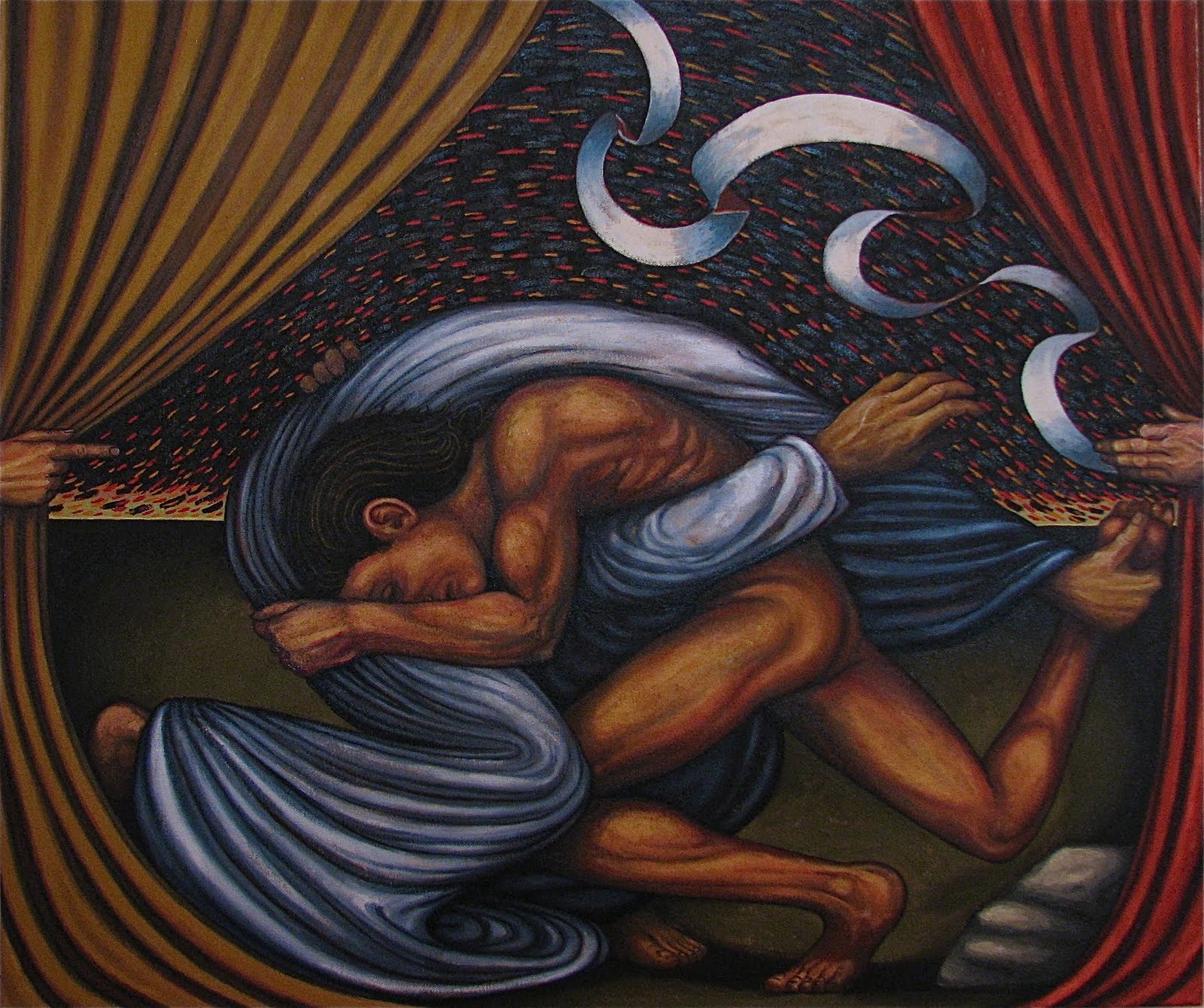
And while the word ebenezer doesn’t appear in our scripture this morning, I couldn’t help but think of erecting stones of hope as I revisited this famous scene from scripture.
Jacob has been striving, wrestling with life, for a while. He got jealous of his older brother Esau and tricked his father, Isaac, into giving him the birthright, rather than Esau who was supposed to receive it as the oldest child. He then gets tricked himself by Laban, the father of the woman whom he wants to marry, Rachel. Instead, he ends up marrying both sisters, having to work a total of fourteen years for Laban before finally getting the woman of his dreams in marriage.
Having so married, he sets off to build a life with his wives and the wealth gained from their dowries. But he finds out that Esau is looking for him. He thinks that Esau is very angry and looking to destroy his brother and take back the birthright that was rightfully his. Jacob eventually turns to face Esau, choosing to meet him, and it’s on the way to meet Esau that we find Jacob, alone, with his family and household on the other side of a river.
Jacob, we don’t know why, has decided to stay on this side of the river by himself. Maybe he needed some introvert space to think through things. That’s what I would need, considering all the striving, wrestling, he’s had going on in his life.
He’s been through a series of hardships. Some brought on my his own bad actions. If not for stealing the birthright, his brother wouldn’t be angry and looking for him. Then, there are other hardships brought on by the bad actions of others: Laban tricking him into marrying Leah before Rachel. And undoubtedly, he had some wounds of his own, what the enneagram refers to as the shadow side: the ways scars of old or unresolved issues can drive us and cause us to act in poor ways as we struggle within ourselves.
We can certainly relate to that kind of life. We have had times where we have struggled with hardships we brought upon ourselves. Perhaps we said something to someone we later regretted. Perhaps we did something to someone we later regretted. Perhaps we did something that caused harm to others. Perhaps it was something else.
Then consider times where something has happened in life that caused you to struggle. Perhaps it’s being tricked by someone, like Jacob by Laban. Perhaps it’s just because of something that happened in life: a health scare or hard diagnosis, a financial threat, a tragedy. It was times like this that my children were remembering when they built their ebenezers.
In both cases, we can find ourselves wrestling internally, struggling to understand what’s going on, why it happened, and how we’re supposed to respond. Then, it can go deeper. Prior to this moment in scripture, Jacob is talking to God, hoping that God will provide but clearly wrestling in his relationship with God. He’s deeply concerned about his very angry brother approaching him, thinking that will mean his destruction. Why would God allow this to happen? Hadn’t he been faithful since his dastardly act of stealing the birthright? Crises in life, whether we bring them upon ourselves, they’re caused by someone else, or they just happen, can lead to crises of faith. Why would a good God allow this bad thing to happen to a faithful person? Why is there still evil in the world if Jesus Christ came and, as we say at communion, “defeated sin and death and destroyed their power forever?”
These are natural questions, things we ask ourselves, a wrestling we do when bad things happen. Jacob’s there in his soul. And maybe that’s why he stays alone, not crossing the river. Maybe he needs to think and sort things out.
The hymn, “Come, Thou Fount,” speaks to the wrestling that comes with the life of faith. “Prone to wander, Lord I feel it; prone to leave the God I love,” the author Robert Robinson writes. Indeed, when he speaks to the ebenezer he raises, it’s because “hither by [God’s] help I come.” He recognizes that it’s through God’s help he’s come through the difficult circumstances, the struggles and challenges; the wrestling. And he both praises God for that deliverance and asks that he not wander again, not need to wrestle again.
We can relate. The life of faith is sometimes a life of wrestling: wrestling with the consequences of things we’ve done, wrestling with the consequences of the things others have done, wrestling with the bad things that happen in life, wrestling with our wounds and shadow side, and above all wrestling with the tough questions of faith: why God, why?
I can hear Jacob asking that question as he remains alone on the bank of the river. In my minds eye, I see him settling in to sleep when this man comes to wrestle with him until daybreak. He wrestles and wrestles and seems to have the upper hand until the man strikes his hip and puts it out of socket. This man clearly is no ordinary man; a man the scripture gradually reveals as God himself. Then God seems to have the upper hand in the wrestling but it’s not over yet. God asks to be let go. But rather than give-in, Jacob does this incredible thing. He says, “I will not let you go unless you bless me.”
I will not let you go unless you bless me.
How often is it the case that when we have wrestlings in our souls, we are tempted to give in? Tempted to walk away? Decide that faith isn’t worth it, that God isn’t good, that a good God would not have allowed this thing to happen to me. Perhaps we have given in, deciding that a good God would not allow these things to happen and so maybe God doesn’t exist or maybe God isn’t for us but against us or maybe God just doesn’t care.
I’ve been there. Part of why I left faith was the thought that, if God was so good, there wouldn’t be the suffering I knew, both internally and in the lives of those around me. That if God really provided, there wouldn’t be these hardships. I could never convince myself that God didn’t exist, so I adopted a posture that said it didn’t matter if God existed or not; God wasn’t good and so a life of faith was pretty well pointless.
In the internal wrestling I was doing, I had given in.
Maybe you can relate. Maybe you have friends or family members who are there. Perhaps they’ve had bad experiences with people of faith, or perhaps they were hurt by an experience at a church, or maybe they just have had some tough things happen in life and they’ve given in to the wrestling. Maybe that’s been true for you.
When facing this kind of internal wrestling, it’s tempting, and even easy, to give in.
But not Jacob. He’s facing that kind of internal wrestling. He’s wrestling with his faith, with God, but he won’t give in. I will not let you go unless you bless me.
Robert Robinson, the author of “Come, Thou Fount,” wrestled for 27 years. He was apprenticed to a hairdresser, but didn’t want that to be his career. He wrestled with that. He tried to understand the divine, feeling a sense of longing for that, and tried various things, including seeing a fortune teller. He wrestled with God, too. One day, he heard George Whitefield preach. This was the same Whitefield who was a contemporary of John Wesley and helped found the Methodist movement. It was in hearing Whitefield’s preaching that Robinson felt his 27 years of wrestling come to an end. He felt blessed by what he heard, he felt a resolution to his wrestling. And he then went and became a minister, serving several parishes and writing hymns.
Robinson didn’t give in. For 27 years he kept wrestling. And God blessed him.
Jacob didn’t give in. For many years, he kept wrestling. And God blessed him.
In the midst of my own wrestling, I found myself one day feeling blessed, feeling resolution to my wrestling. I had much to unpack and deal with, but ultimately it came down to the practice of vulnerability in leadership and pastoral ministry. I knew God was calling me that way and I believe vulnerable leadership is the most effective kind of leadership. But I had to deal with my own stuff first.
I recall in the midst of wrestling saying to God something similar to what Jacob says to God here in the scripture: I won’t stop wrestling until you’ve completed your work. In other words, I will not let you go unless you bless me. I demanded that God bring to completion what God had begun in my internal wrestling. I did what Jacob does here in the scripture.
And that made all the difference.
Wrestling comes with the life of faith. Deep, hard, internal struggles are a part of living the life of faith as we grow in our relationship with God. And when we encounter such wrestling, we should be bold like Jacob, saying to God that we will not give in, we will not let go, we will continue to wrestle, until God has blessed us.
Think back in your life to wrestlings that are now done. We all have those: times where we can see how God blessed us because of the wrestling. Times where we can see how God came through and how we’re now better and able to bless others because of the wrestling we did. I have heard powerful testimony from cancer survivors who, feeling blessed by their survival, are the greatest blessing to those who have recently received cancer diagnoses as they walk that journey together. The power of twelve step programs comes through in sponsors: those who have wrestled with their addictions choose to walk the path with those who are just starting the journey of addiction, bringing the blessing of their recovery to someone just beginning.
Jacob was blessed from his wrestling. Through him, the nation of Israel was born. Through him, God continued fulfillment of God’s promise to his grandfather, Abraham. Through Jacob, now renamed Israel, the people of God were blessed.
We are blessed to be a blessing. And blessing is what can come through from a period of wrestling, from a hardship that has caused us to question our faith and question God’s character. It’s tempting to give in during those times of wrestling. Those are very difficult times indeed.
But Jacob shows us this morning: when wrestling deeply, internally; when struggling with God, don’t give in until God has blessed you. Be bold like Jacob and demand a blessing.
For a blessing will come. A special imparting of God’s grace will come as a result of our wrestling. As Paul says in Philippians, “I am confident of this, that the one who began a good work in you will continue to complete it until the day of Jesus Christ.” At the end, we will know God better and we will be more effective witnesses for the gospel of Jesus Christ. At the end of our wrestling, we will be able to help others who are beginning the same journey through hardship. At the end, God will be able to do more through us. The wrestling will come to a completion. A blessing will come. And God will use that blessing to bless others.
The task for us, in the midst of wrestling, is to be bold like Jacob: demand a blessing and don’t stop wrestling until it comes.
That’s hard, though. It’s really hard. How do we find encouragement in the midst of wrestling?
I’ve had my own wrestling going on the last few weeks. Sitting in my chair in our den, journaling as one of my practices for dealing with this wrestling, I have glanced often at a glass ball on top of the piano. Every January and February, Jekyll Island hides plastic balls around the island and invites the public to come on a scavenger hunt for them. Many years now, we have gone down and done the scavenger hunt but never found one. Several years ago, we went to do the scavenger hunt as a way to get away after I had finished the period of wrestling I had mentioned earlier. It was great to get out of town and get some good time in with family, marking the end of that wrestling and noting the ways I felt God had blessed me as a result.
On the way off the island, we stopped at the visitor’s center by the toll booths. If you find one of the plastic balls, they give you one of these glass balls for free. But, of course, they sell them, too. I’d always admired them. Dana went in and told me to pick one out. She wanted to get one to mark this moment of blessing, this end to my wrestling, this big moment in my personal development.
So I picked one out and it’s sat in homes we’ve had since. It’s not made of stone but it’s still an ebenezer for me: a symbol of hope. When I have wrestled in the years since, just like this latest time these last few weeks, it has reminded me that God is good to complete the work God started: that a blessing will come from my wrestling. It’s encouragement to not give in.
This is why ebenezers are important. They remind us of when God has been faithful through our wrestling in the past. They serve as markers in our lives. When my children made their ebenezers to remember Papa the Great and Quincy, they were marking the end of their own wrestling with death and loss. They were marking how they’ve experienced hope through having wrestled with such hard and adult concepts. When Jacob names the spot of his wrestling Peniel, he’s marking that space as a symbol of hope; an ebenezer.
We need ebenezers in our lives. Wrestling with God comes to us all. It’s part of the life of faith. And it can be all consuming, just like it was for Jacob. When we wrestle, we need ebenezers, symbols of hope, to remind us that God is faithful, that God will bless us, and that from that blessing, we will be able to bless others in new and profound ways. We are blessed to be a blessing, including from the times of wrestling.
Let us raise our ebenezers. As a sign of this hope, Payton and I will offer anointing with oil as we’ve done before; the traditional sign and seal of the healing power of the Holy Spirit in our lives. If you’re wrestling this morning, if you’re struggling this morning, or if you otherwise feel a need for healing, as we sing, “Come, Thou Fount” in a few moments, come forward as you feel led to either of us and we will anoint you.
What are ebenezers in your life? What reminds you of times God has been faithful and blessed you through wrestling? And where are you wrestling right now? Don’t give in. Demand a blessing from God and don’t let go until you’ve received it. Be bold like Jacob.
God is faithful. The good work being done in you through the wrestling will come to completion. You will be blessed. And then, you will go and be a powerful blessing to others.
Let us raise our ebenezers, for there is hope no matter our wrestling.
In the name of the Father, Son, and Holy Spirit; Amen.
 Ted Goshorn