Many unintended consequences causing much trouble.
In 1919, leaders from the Allies of World War I gathered in Paris to map out the terms of the peace; what would become known as the Versailles Treaty. This treaty, over and against the wishes of President Woodrow Wilson, established significantly punitive damages against the losers of the war, particularly Germany. The history has long been told that this treaty played a large role in creating the conditions for World War II. Without this particular treaty, or had Wilson triumphed in the vision of his famous 14 points, historians say that it’s possible we would not have had World War II.
That is a famous historical story, of which I’m sure many of you are familiar. But lesser known is the story of Nguyen Ai Quac, a student in Paris, who was studying politics in preparation to return to his native country. He sympathized with the communism that was then in vogue; Lenin having successfully established the Soviet Union only two years prior. But, he had not made up his mind. He wrote to the Allies, asking for their help to get France to release their colonial hold on his home country, allowing them the right of self-determination that Wilson’s 14 points championed.
The response to his request led to many unintended consequences and much trouble as a result. This is also the case in our scripture this morning. Let’s hear the story of Hagar and Ishmael being sent away in Genesis 21:
Scholars refer to this passage as a “text of terror.” Here, we have a vengeful, spiteful, jealous, Sarah demanding that the competition get banished. And she knows, without doubt, that such banishment could easily mean death. As a slave, Hagar would have few resources of her own, and so to banish them into the desert with just some water, no where to go, no plans, no skills to put to work, would almost certainly mean death. But Sarah doesn’t care. All she can see is her jealousy, her desire for revenge, and her spite, which will almost certainly lead to the death of a woman and child. Terror indeed.
And all of this is terribly ironic because Ishmael was Sarah’s idea in the first place. When Sarah realized she was barren, she figured God was displeased with her. That was the cultural way of thinking during this time in history: if women could not conceive, it was because they had angered or upset God somehow. At one point, God comes and says that Sarah will give birth; making that promise. But rather than make penance to God, rather than seek to repair the relationship, and rather than believe that God would fulfill God’s promise, she turns to Abraham and suggests that he father a child with Hagar. Sarah doesn’t seem to care about God’s promises, nor about her relationship with God; she’s already decided her course of action. She convinces Abraham to father a child with Hagar, which produces Ishmael.
Then, when Sarah does conceive, per the promise of God, and Isaac is born, Sarah becomes vengeful, spiteful, and jealous toward Hagar. She becomes exceedingly concerned about their presence. She believes that Abraham will allow Ishmael to inherit in part, that Abraham will treat Ishmael as an equal son with Isaac, and Sarah just can’t have that. In fact, her contempt is so great, she cannot even bring herself to utter their names. Note that, when she’s telling Abraham to send Hagar and Ishmael away in our scripture this morning, she never uses either of their names. Instead, it’s “this slave woman” and “her son.” Sarah’s contempt is complete.
This is Sarah acting out of sin. And it’s her compounding sin upon sin. She sinned when she decided to have Abraham father Ishmael, despite God’s promise that she would conceive. And now, rather than confess her sin and seek God, she piles more sin on top of that sin with her demand to have Hagar and Ishmael cast out.
She’s acting out of sin, with many unintended consequences causing much trouble.
Back in Paris, Nguyen Ai Quac’s efforts, and those of the Allies he successfully convinced, failed. His home country would remain colonized by France. Nguyen, already sympathetic to the cause of communism, went back to his home country disgusted by the Allies, by democracy in general, and hostile to western powers. Upon his return to his country, he founded a communist government, the same one that would later fight the southern half of his country, and changed his name to Ho Chi Minh. Had his efforts been successful in 1919 in France, it’s possible Ho Chi Minh would have founded a different-style of government or, at a minimum, been less hostile to western forces, perhaps preventing or mitigating the Vietnam War.
World War II and perhaps the Vietnam War were unintended consequences of the Versailles Treaty. But, for Georges Clemenceau, the president of France, and David Lloyd George, the Prime Minister of Great Britain, the terms of the treaty were good, they were just, they were right, because they were vengeful. These leaders wanted revenge, they wanted to hurt the losers. In short, they acted out of sin, with many unintended consequences causing much trouble as a result.
Of course, they couldn’t see that, but that’s what happens when we act out of sin.
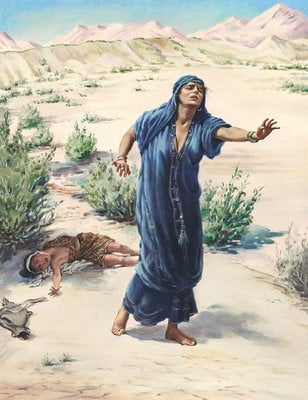
Back in our scripture, Hagar is wandering in the desert, having been banished there by Sarah and Abraham. As they wander, Hagar and Ishmael slowly succumb to thirst. The heat, the barrenness of the land, and Hagar’s inexperience as a nomad, cause great trouble. So much so, that Hagar leaves her son under a bush to die, walking away because she was unable to fathom watching her son die. Put yourself in Hagar’s shoes. Imagine being so thirsty that your child is dying, no water in sight, and you can’t go back to your family because they’ve banished you. Her despair is real, her agony is complete, and she calls out to God in the midst of it.
This is the trouble Sarah could easily have foreseen. In fact, perhaps she preferred this outcome; the vision of Hagar and Ishmael dying in the desert. The skin of water is gone, they’re in the middle of the desert, and completely hopeless. Death is imminent. And it’s Sarah’s fault; a consequence she could have seen herself.
But then there are the consequences she couldn’t see; that she never would have considered. Ishmael later marries an Egyptian, as Hagar herself is from Egypt. Through his lineage, the Egyptians grow mighty and powerful, such that they eventually enslave the Israelites in the famous story of the Exodus. In some ways, Sarah is responsible for the enslavement of the descendants of herself and her son, Isaac.
Then, consider the animosity that continues among the three Abrahamic faiths, especially between Islam and Judaism. Jews, and Christians, too, trace their lineage back through Isaac to Abraham, calling Isaac the legitimate son of Abraham and heir to the covenant God established with Abraham. Muslims trace their linage instead back through Ishmael, calling him the legitimate son of Abraham and heir to the covenant God established. This is part of the foundation of conflict between these religions and among all three Abrahamic faiths.
Sarah, of course, wouldn’t have seen either of these consequences, but her sin set in motion the events that led to the Exodus and to the continued discord among the religions that come from her husband’s lineage. Many unintended consequences causing much trouble.
That’s what happens when we act like Sarah, when we act out of sin: we cause unintended consequences and much trouble as a result. I have often said from this pulpit that when we’re following God, living a life out of God’s love and grace, God does far more than we could ask or imagine. That positive image has a negative counterpart: the same is true for our sin. When we allow sin to determine our actions, the consequences go beyond what we could imagine, to many unintended consequences causing much trouble.
We might think, like Sarah, that our actions are limited to the immediate: that acting out of spite and jealousy only holds consequences for Hagar and Ishmael. We might think, like Allied leaders at Versailles, that our desire for revenge and justice only hold consequence for the object of those feelings: in this case, the nation of Germany. But of course we see in these two stories that such is not the case.
And perhaps we can look back at our lives and see the same holds true for us. Think of times that you acted out of sin. Perhaps you were angry and acted out of that anger. Maybe you, like Sarah, were jealous. Maybe you, like the Allies at Versailles, were vengeful. Maybe there was a moment of envy, or lust, or contempt, that led to acting sinfully. That sin spreads like a virus, beyond the people we aim our actions against, leading to many unintended consequences and much trouble. Perhaps you can look back at your life and see how an action from years ago has led to such unintended consequences and trouble.
I can look back at my life and see such situations. I can think of times I acted in anger, especially when I was a young adult, and the trouble it caused. I can think of times that I made decisions out of pride that led to unintended consequences and trouble. I can think of several situations just like this. I can think of times I acted like Sarah. Perhaps you can, too.
What are we to do when we act like Sarah?
The very fact that scripture has led us to ask this question is one of the things I most appreciate about scripture. It doesn’t shy away from telling stories that are hard, even terrible. It doesn’t shy away from painting heroes of scripture, like Abraham and Sarah, in a negative light. One might think that the authors of scripture would have only wanted to paint themselves and their history in a positive light, suggesting that they were the greatest, the best, the most favored by God. Many histories, written by nations, are written in just that way! But that’s not what scripture does. Scripture shares with us the good, the bad, and the ugly. And here, we have the ugly. I appreciate this about scripture so much because it allows us the opportunity to see ourselves.
And if we’re bold enough to be honest with ourselves this morning, we have all been Sarah at one time or another, acting out of sin, with unintended consequences of that sin causing trouble. So what are we to do when we act like Sarah?
In the desert, Hagar calls out to God, weeping at the imminent death of her son from thirst. God hears her and hears her son, who, as he is literally dying of thirst, must certainly be wailing under that bush out of fear, misery, and pain. It’s a terrible, tragic, scene here in the desert. And God doesn’t have to act. God has chosen Isaac and Sarah, God has covenanted with them. There is no promise for God to fulfill here, there’s no covenantal obligation by God for Hagar or Ishmael.
And yet, God sends an angel to speak to Hagar, letting her know that God has heard Ishmael’s wailing and taken compassion on them. The angel tells Hagar to go, get her son, and walk on because God will make a great nation out of Ishmael. In my mind’s eye, I Imagine this scene: Hagar summoning her last remaining strength to run to her son, believing this promise of God, and then, in the haze of the desert, that haze caused by heat and dust swirling, Hagar sees a well come into focus. She gathers her son up and runs to the well, drinking from it until death no longer seems imminent, crying tears of gratitude and relief for the salvation of her son.
God was under no obligation to act, but God chose to act out of compassion anyway.
Sarah’s sin caused many unintended consequences and much trouble. God took compassion on Hagar and Ishmael.
So what do we do when we act like Sarah?
First, we confess our sin. Remember that Sarah’s sinful action here is the result of a previous sin: encouraging Abraham to father Ishmael with Hagar because she did not believe that God would fulfill God’s promise to her. Sarah tries to fix her past sin by sinning again; this time, banishing Hagar and Ishmael to an almost certain death. Instead, she should have confessed her sin to God. Then, she could have acted Godly, rather than sinfully, when she saw Isaac and Ishmael playing together. Then, she would not have sent Hagar and Ishmael into the desert, with all the consequences, both intended and unintended, as a result.
Second, after we have confessed our sin, we do as we see God do with Hagar and Ishmael, we practice compassion. We have sinned, yes, but when we realize we have sinned, our tendency is to beat ourselves up, be hard on ourselves, and talk down to ourselves. That’s never the model of scripture. When someone sins, realizes it, and confesses it, forgiveness from God is immediate. Scripture shows us this reality time and again, best exemplified perhaps by Jesus with the woman at the well in the gospel of John. Jesus says to her, “go, and sin no more.” Those are the words God speaks to all of us when we sin and confess that sin. Forgiveness is immediate, and the sin is not held against us. Neither should we hold it against ourselves. We are released from guilt, from beating ourselves up, from feeling terrible about ourselves. We should give ourselves the same compassion God gives us.
And that’s true even if you can look back at a time you acted like Sarah and see the unintended consequences and trouble you caused. Even if it was great. Even if it ended relationships. Even if it ended a marriage. Even if it destroyed a fortune. No matter what, we give ourselves compassion after we have confessed to God, because that’s what God does for us when we confess our sin.
And beyond this, when we are Hagar rather than Sarah; when someone has sinned against us and we are in grave trouble as a result, when someone else’s sinful action has caused unintended consequences for us, when we experience much trouble not because of our own actions, but because of someone else’s sinful actions, we should act like Hagar: crying out to God. Only God can fix our situation. Only God can get us justice. Only God can right a wrong. It’s terribly tempting to want to do that ourselves. That’s what happened at Versailles: humans trying to force justice and right a wrong on their own. Sarah attempted the same thing, piling sin upon sin. Only God can create justice. Only God can rectify our situation, born of someone else’s sinful actions. And so, like Hagar, we should cry out to God for aid, for help, believing that God will provide.
Hagar, not Sarah, is the exemplar of faith in this story. Unlike Sarah, she believes in the promise of God to provide, which leads to salvation from death for her and her son. She shows us to cry out to God when we’re the ones who have been on the receiving end of someone else’s sin. And apparently, she also taught compassion to her child. When Abraham dies in chapter 25, Ishmael returns to his father to help Isaac bury him. Abraham has many other children at this time, Sarah is long dead, but scripture gives only their two names as the children who bury Abraham. Had Hagar passed down to her son the anger, bitterness, resentment, and even hatred she must have felt for Sarah, and even perhaps for Abraham, Ishmael would not have returned.
Hagar taught compassion to her son. Hagar acted out of faith in God. Hagar is the exemplar of faith for us this morning.
Our actions carry consequences, both intended and unintended, and can cause good or trouble. When we act out of sin, when we act like Sarah, we do a world of harm, in ways we can see and not see. When we act Godly, like Hagar, we put our trust for justice in God’s hands.
With whom do you relate this morning? Sarah or Hagar?
If Hagar, cry out to God. Only God can get you the justice and peace you desire.
If Sarah, confess your sin and experience the power of God’s forgiveness. God says to you this morning, “go, and sin no more.” Give yourself the compassion God gives you today.
And for all of us, whether you relate more to Hagar or Sarah, the sin that has caused so much trouble and resulted in so many unintended consequences no longer need define you nor your family. When we confess, if Sarah, or cry out to God, if Hagar, we give God that sin to resolve. Only God can do that, and when we place that sin in God’s hands, God redeems it. When we confess, when we cry out, God takes our sin and turns it to good. Sin, whether or own or someone else’s, need no longer define us.
That’s the good news this morning. Sin, regardless of how little or how great its impact has been in our lives, need no longer define us. God is greater than our sin. Confess, cry out, and go, and sin no more.
In the name of the Father, Son, and Holy Spirit; Amen.
 Ted Goshorn